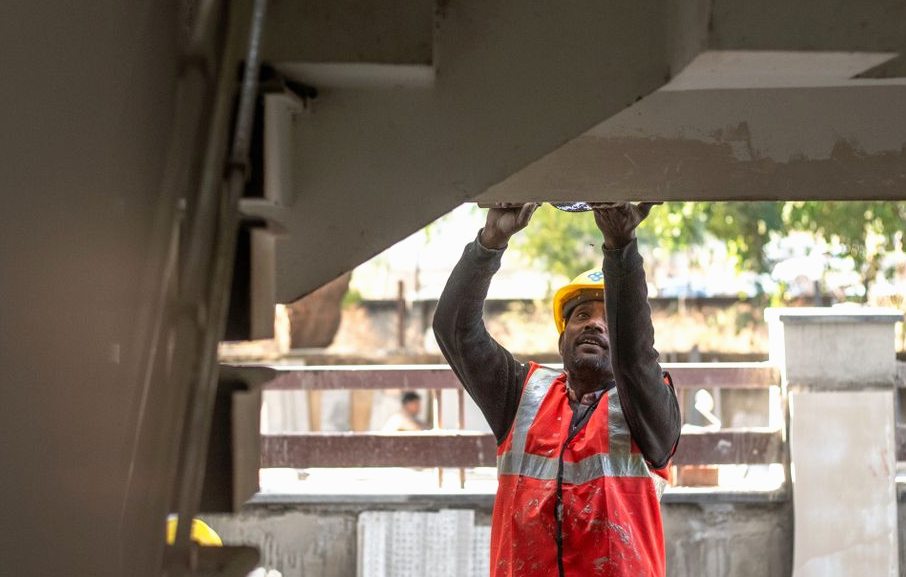
What a concrete contractor actually does
The work starts below the slab. Before any concrete shows up, we look at what the ground is doing, what loads the slab has to carry, and whether the soil will move. In the river valleys here the clay is expansive. It swells when wet and shrinks when dry, and that heave can crack a slab that was fine the day it was poured. It shapes how we prepare the base and where the reinforcement goes.
Next we set concrete forms and stakes to hold the shape while it cures, then place and align the reinforcing steel on the prepared base. The steel is what keeps a slab from pulling apart when the ground shifts.
The pour is a set sequence. We place workable concrete near its final position and consolidate it around the forms and reinforcement to remove air pockets, because trapped air weakens the slab and gives water a path in. Then we screed it with a straightedge to cut off the excess and bring it to grade. The grade is what sends water off the slab instead of letting it sit.
How the work is priced
Most of the cost sits in preparation, forming, reinforcement and finishing, not in the concrete alone. That is why two slabs that look alike can price very differently.
For finished surfaces, polished concrete runs roughly $2 to $16 per square foot, depending on the condition of the existing slab and how much grinding it needs. Exposed aggregate typically runs $8 to $12 per square foot. Those are surface finishes, not structural pours, but they show the kind of range you can expect.
Tell us the size and type of job on the phone and we will talk through a ballpark range. Final pricing waits until we have walked the site, since the base, the access and the existing slab push it toward the low or high end. Our written quote lists prep, forms, reinforcement, concrete and finishing as separate lines.
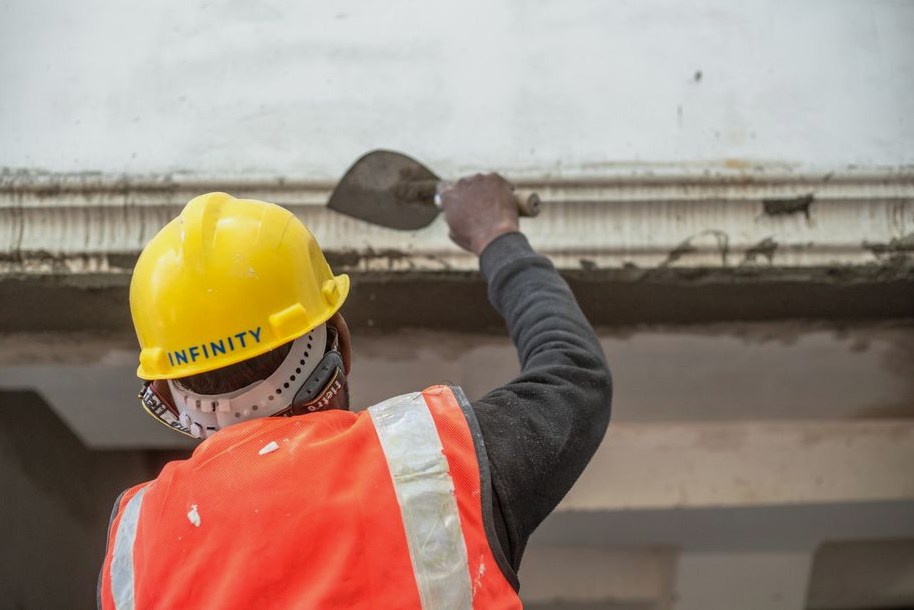
Repair or replace
Plenty of concrete here is old. The median home in Cedar Rapids was built in 1973, so many slabs, steps and driveways have been through decades of wet seasons and moving clay. That age is why we look at the base and the steel under a damaged slab before we quote a patch.
A patch holds when the concrete around it is sound. If the base has washed out, the reinforcement has corroded, or the slab keeps heaving because the soil under it moves season after season, a patch will not hold. In those cases we quote a replacement instead. The question we answer for each job is whether the slab can still do its work for a reasonable number of years.
Timing, curing and weather
A patch goes faster than a new slab, which needs prep, forming, reinforcement, the pour and finishing before curing even starts. Curing is the part that cannot be rushed. Concrete gains strength over time, and loading it early is how surfaces get damaged. We will tell you when your slab is ready for use.
Precipitation here is steady through the year, so we plan pours around the forecast and expect some schedule moves. We will not pour into standing water or onto a frozen base. We set the pour date after the site walk, when the prep work and the forecast are both known.
What you will see on pour day
By the time the concrete truck arrives, the forms and stakes are set, the grades are checked and the steel is in place. The pour moves quickly because concrete does not wait, so the placing, consolidating, screeding and finishing happen in one continuous push.
After that we tell you what to stay off and for how long. If you have a project in mind, call us.
Start to Finish
In practice, this is what gets done:
- Grade and compact the subgrade, then place and compact an aggregate subbase where specified.
What to Expect to Pay
Use these numbers to budget, and we'll explain what moves a price up or down.
$4–$18 per sq ft
Updated October 2026